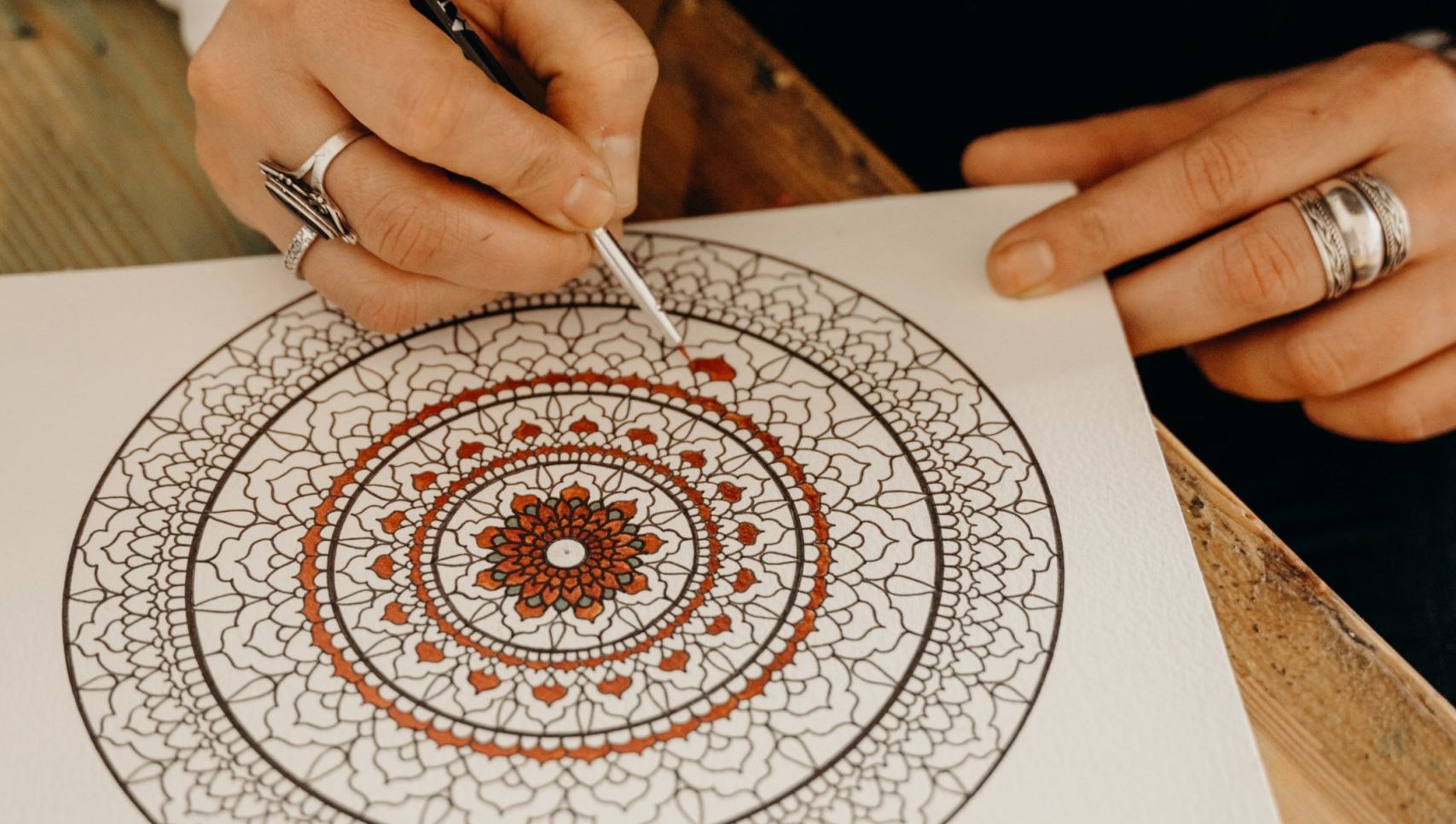
Have you heard about the new trend, mandala coloring? As kids, we all did this at some point, but when was the last time you colored in a mandala as an adult? That’s exactly what this new hobby is about: mandalas for adults. And coloring mandalas isn’t just fun, it can also have a calming and relaxing effect. In this article, we’ll explain what’s going on psychologically when you color mandalas and how to get started.
More than a childhood memory
The tradition of drawing and coloring mandalas originally comes from Tibetan and Indian cultural traditions and is therefore rooted in Buddhism and Hinduism. By now, however, it is widely known and is no longer practiced only for religious reasons. The word “mandala” roughly translates as “radiating from the center.” This is reflected in the typical structure of mandalas: an image made up of geometric shapes arranged around a central point. Because of their relaxing effect, mandalas are already used in mindfulness courses and for meditation.
The Swiss depth psychologist C. G. Jung conducted research on the psychological effects of mandalas as early as the beginning of the 20th century. His work suggested that mandalas can evoke different emotions in us. On the one hand, their symmetrical structure can convey a sense of wholeness and offer a feeling of meaning, direction, and purpose. On the other hand, mandalas can also spark feelings of curiosity and fascination. Through the repetition and uniformity of their symbols, mandalas can resonate with our subconscious. Depending on the colors, symbols, and the overall mood of the image, different inner responses may be stimulated.
While coloring, we can create a sense of inner order and reach greater balance and calm. Mandalas can help us relax, let our thoughts settle for a moment, and focus fully on the act of coloring. This focus can improve concentration and fine motor skills. Creativity doesn’t get left behind either; it’s actively encouraged. Mandalas are therefore a great way to escape the hustle and stress of everyday life and reconnect with our inner center. That said, it’s important to note that while mandalas can be an excellent relaxation tool, they are not a substitute for certified relaxation courses or professional therapy and treatment. However, they can be a very helpful support.
Our tips for your mandala relaxation
If you feel like drawing and coloring mandalas yourself, here are a few tips and tools to help you get started with your new, relaxing hobby:
- Choose a mandala that you like in terms of its shapes and overall look. Online, you can find many free mandala templates for adults to download, in addition to children’s mandalas.
- Take your mandala to a quiet place where you won’t be disturbed and where you feel comfortable.
- Start coloring the mandala. Colored pencils or fine liners work especially well.
- Try not to overthink which colors you choose for which shapes or areas. Just start coloring intuitively.
- For the full “mandala feeling,” try coloring your mandala from the outside toward the inside, moving toward the center. This reflects the idea of turning your attention inward and finding inner balance through the process.
- Focus completely on coloring. Try not to get distracted by background noise such as the radio, TV, or music. Instead, enjoy these moments of quiet and concentration.
- Don’t be too perfectionistic. It’s not about the mandala being perfectly and completely finished. With mandala coloring, it’s about the process more than the result. So let go of pressure to perform and perfectionism, and simply enjoy the moment.
Take time for yourself
Mandala coloring is a simple way to create small islands of calm in everyday life, with no big effort but a noticeable effect. Take a few minutes, choose your colors intuitively, and let your mind quiet down a little. Have fun trying it out, and enjoy a relaxing break!
Further information on the topic can be found here:
Zhang, M.-Q., Liu, X., & Huang, Y. (2024). Does mandala art improve psychological well-being in patients? A systematic review. Journal of Integrative and Complementary Medicine, 30(3). https://doi.org/10.1089/jicm.2022.0780
Dias Alves, M., Olmi, E., Durand, J.-Y., Mitri, F., Knefati, Y., & Vion-Dury, J. (2024). Coloring complex shapes decreases patient anxiety in three care environments: A pilot study with color analysis. Frontiers in Psychology, 15, 1336202. https://doi.org/10.3389/fpsyg.2024.1336202