

Our eyes take in about 10 million pieces of information per second and pass them on to our brain. So, they work at full speed all day long. To be able to make even the smallest movements, a large number of small eye muscles are permanently active. Particularly, digital media present many colorful and moving stimuli that irritate and strain the eyes in the long run. Too long “close-up viewing” of screens or cell phones also puts a lot of strain on our eyes. It’s time to give them a break! In this article you will learn more on how to relax your eyes.
Structure of our eyes
Simplified, the human eye consists of an eyeball, which sits as a spherical body in the eye socket and can rotate in all directions. The eyeball includes the vitreous body, the lens, and the anterior and posterior eye chambers. The visible part of the eye consists of the cornea, which rests on the pupil and iris. Behind the pupil is the lens. The eyeball is covered by the dermis, choroid, and retina, as well as surrounded by numerous, very fine muscular cords.
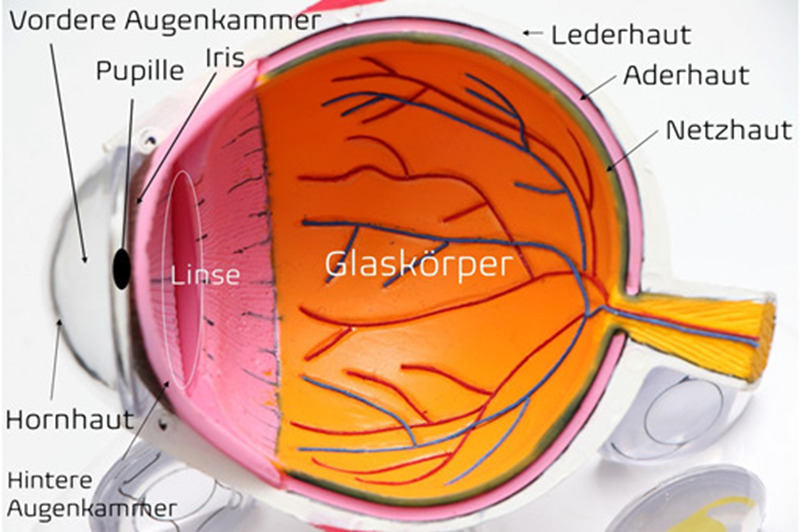
Legend: From front to back: Cornea, anterior eye chamber, pupil, iris, posterior eye chamber, lens, vitreous body, dermis, choroid, and retina.
What happens when we sit in front of a screen for too long?
The increase in display and screen times puts strain on our eyes. Particularly, cognitive tasks that require us to concentrate for a long period of time as well as fast, digital stimuli strain our eye muscles. These are very dynamic and ensure that our eyes perform up to three movements per second. This allows us to react very flexibly and actively to stimuli. The ciliary muscle is particularly important, as it is responsible for the alternation of contraction and relaxation and ensures that our lens constantly changes shape to maintain a clear image. Particularly during close vision, e.g., when doing focused screen work, we tense the ciliary muscle and thus curve our lens. After longer periods of screen time, the tension of the ciliary muscle predominates since there is a lack of countermovement – the lens does not return to its rounded shape. This has a negative effect on the flexibility of our eyes and it becomes more difficult to move the lens into different shapes. However, in order to be able to switch between seeing near and distance objects, we need this change in shape, and in the long run, limited flexibility can lead to nearsightedness.
How can we protect our eyes at work?
Approximately 18 million people work in offices in Germany. With an average of eight working hours a day, employees and managers are exposed to increased eye strain. To prevent eye problems, however, some mistakes can be avoided at the workplace:
- Don’t focus on the screen or cell phone all the time – take enough breaks!
- There should be as much distance as possible between a screen and your eyes. With larger screens, you need at least an arm’s length of distance.
- Suitable lighting conditions: It should be neither too bright nor too dark at the workplace and blinding light reflections on the screen should also be avoided as far as possible.
- Try to consciously blink more often. By staring at the screen for a long time, we move our eyes less, which means that there is less tear fluid to sufficiently moisten our eyes. As a result, our eyes become dry and start to sting.
- Drink enough during your work hours to further moisturize your eyes. Doctors recommend at least 1.5 to 2 liters daily.
- Ventilate regularly to counteract dry air from heating or air conditioning.
Three exercises for stressed eyes
In addition, you can try these simple exercises to relax your eyes at work.
Switching your gaze
The next time you sit in front of your computer screen, try the following exercise: Extend your thumb and then start by looking at the tip of your nose for 5 seconds. After that look at your thumb for another 5 seconds, and finally focus your gaze on any object in the distance for 5 seconds (for example, you could look out the window at a car).
Put your warming palms on your eyes
Warmth is a great way to relax tired and inflamed eyes. It’s as simple as this: Rub your palms together until they are nice and warm (for about 15 seconds). Then place your warm palms on your closed eyelids and take a few deep breaths in and out. Repeat this exercise as often as you would like.
Draw an eight
For this exercise you may sit or lie down comfortably and then close your eyes. Now, visually imagine an 8 and trace the line of this 8 by moving your eyes. You can do this going from top to bottom or from bottom to top. Alternate directions going from right to left and from left to right. Repeat this exercise five times each side.